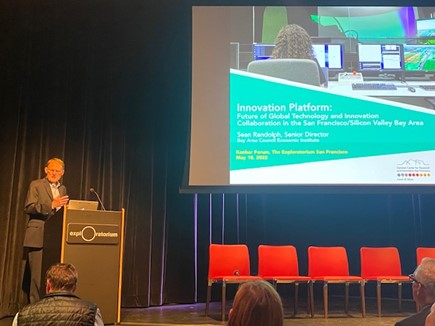
Sean Randolph, Senior Director, Bay Area Council Economic Institute, author of the Innovation Platform Report: The Future of Global Technology and Innovation Collaboration in the San Francisco/Silicon Valley Bay Area
The event included 3 panel roundtables with a variety of leaders from Consulates, incubators and accelerators as well as venture capital firms and research centers. The report researched whether the Covid pandemic had negatively impacted the presence of foreign representation in the San Francisco Bay Area.
While the pandemic saw most countries and foreign entities temporarily closing down their physical offices in 2020 and into 2021, a lot of them adapted and went virtual, or ended up offering a hybrid model of operation. The key takeaways of the presentation of the report for LBC were the following:
The majority of foreign centers have reopened in 2022 with a number increasing their activity in the San Francisco Bay Area.
The core mission of the foreign presence remains unchanged: even though other locations across the US and the world have grown in significance, they believe the San Francisco Bay Area will remain the premier global center for innovation and the place where the script for Digitalization is being written.
Many Consulates have now appointed “Tech Ambassadors” to their outposts in the San Francisco Bay Area. This move reflects the belief that digitalization and tech trends are still largely initiated here. Capturing these trends and momentum can help countries and start-ups form strategies and craft policies to help promote and better manage technology.
Until now the European Union has been represented on a rotating basis by the Consuls General of European nations already represented in the region. In the Fall of 2022, the European Union will open a full time, professionally-staffed office in San Francisco. It appears this will be the only global office for the European Union outside a Capital city.
The report found that while the pandemic certainly paused activity of globally headquartered operations in the San Francisco Bay Area there is a resurgence of activity in 2022. The world of venture capital and unicorns has become more evenly distributed which is a good thing for start-ups and local ecosystems. LBC has witnessed the growth of other ecosystems where we are present: namely in Portugal where there has been a healthy growth of start-ups, in 2015 there was just one Portuguese unicorn in Farfetch. There are now 7.
However, the status of the San Francisco Bay Area as a global hub for technology development and innovation process remains strong. The Bay Area continues to have a significant volume of founders, lawyers, investors that have successfully failed and succeeded in scaling companies. It still has a concentration of leading universities, fueling the talent pool, encouraging risk taking and entrepreneurship and the creation of new companies.
And this is still a place where you can meet a founder from Europe and in the same day, or at the same event, meet several others from far flung places like India or Japan. With their presence in the Bay Area and focus on Innovation, Tech scouting and near shore, LBC is witnessing and contributing to the re-opening of Silicon Valley and the San Francisco Bay Area, participating with the likes of Axis Innovation and MasterCard, EDP and the Pasha Group to connect to thought leaders in Silicon Valley.
About LBC:
LBC is a boutique management and innovation consulting and digital transformation firm focused on high quality engagements. LBC has an offering specific to Innovation which is captured under our Global Strategic Innovation Programs. We’ve produced 37 immersion programs in Silicon Valley, involving more than 500 executives from several countries. Our next Global Strategic Innovation program will run from the 10th to the 14th October.
My friend and LBC business partner, Jonathan Littman, a Bay area seasoned author and mentor with worldwide experience, Founder of SmartUp, took me to a remarkable and memorable session at the Stanford d.school Launch Pad.
Each Spring quarter d.school professors Perry Klebahn and Jeremy Utley work with 10 new ventures to launch a real business in just 10 weeks. Of the many things I learned or reconfirmed, I share three important take-aways which are critical for an idea to evolve successfully into market. Launchpad has a proven track record. In the last 9 years, Launchpad startups that completed this 10-week college acceleration program have raised more than $200 Million in venture capital funding, hired more than a thousand people and created more than $500,000,000 in value. Of the 100 companies launched, 65 are still in business.
Yes, and…
Stanford Launchpad promotes a positive spirit of collaboration and creativity. Participant entrepreneurs learn the rule of “Yes, and…”, instead of “No”, “Yes, but …”, or similar expressions that kill ideas from the very start. No one will tell you that your idea is no good. Instead, entrepreneurs are challenged to test their ideas as early as possible. The best judge is the potential end user or paying-consumer, so entrepreneurs are challenged to test and retest and get real data right from the start. Observing, speaking and testing with the paying consumer and obtaining financial sponsors as early as possible are key success factors.
Customer needs and User centric design before Business plan
Over and over, I see entrepreneurs and especially corporate entrepreneurship programs jump too early into a traditional business plan. At Stanford Launchpad the main objective is to achieve an excellent product-market fit before starting to think of a business plan. The key is to define the customer need and to develop a user centric design. Ideas are developed following a very simple but efficient methodology:
Identify the Target User – as detailed as possible, by using personas and other methods,
Identify and understand the Pain to be addressed – in as much detail as possible so that you can address it and test it, the focus is the pain, not the idea.
Identify and design the Key Features of the solution you are proposing – customer centric design, defining the necessary winning patterns and features necessary for the end user to be eager use and pay for the solution.
Experiment and collect data – as much as possible with real customers and over and over again.
Experimental learning
The latter point of the methodology is key to success – it is essential to engage in deep experimental learning on how your initial idea should evolve in order to succeed in the market.
The sooner you test your assumptions through direct interaction with end users the better. It’s important to commission multiple experiments in parallel rather than in sequence, in order to save resources and to be as fast as possible in focusing in the right direction. Experiments should be simple and objective in order to teach you quickly. Experiments shoud also be narrow in order to provide meaningful data.
How can you participate
Above all, Stanford Launchpad provides great insights on how accelerations should be conducted.
Though only Stanford students can participate in the formal April to June Launchpad acceleration program, this year the professors created the Launchpad Venture Club, giving an opportunity for the public to participate in weekly sessions. From January through May. And everyone can attend Night Launchpad, the public demo day at the Stanford D.School for Launchpad teams at the end of April.
By Marcelo Franco de Sousa, Managing Director at Matcerâmica
A real upgrade to the software in the brain: my mindset is much richer after I returned from San Francisco.
On the basis of all visible differences there is the way they use cognition, not necessarily because Americans are smarter than Europeans, but surely because they exploit cognitive abilities in a much more assertive way.
It is imperative to understand their culture, not to do the same, but to raise our standards of competitiveness.
I highlight three factors that I have observed and consider to be key in the American business culture:
Speed | Focus | Commitment
At speed they are like time, they never stop, not even for lunch, they do not waste time on minor things and they do not complain all the time.
In focus, the attention given to the market, namely the importance of sales, is truly impressive: sales, sales and sales.
In compromise it is not about not reaching the finish line, failure is not a reason to give up or discourage or even disqualify, failure is simply a stage of the process, as in science.
Trust in people, believing in someone else’s ideas/projects and the investors’ availability to take risk, are totally different from our banking reality.
For investors, the decisive factor is a project that solves a problem for which a solution has not yet been found.
For the initial valuation of the project the determinant is the growth rate of the business/sales.
It is evident that scale – in everything, is a determining accelerator.
No one has guaranteed places. Employment relationships are much different, only distinctive competences create bonds.
Of course, there are a few other factors, or values, such as non-risk aversion, where interest and curiosity are clearly ahead of fear, of the unknown or of the fear of failing.
Also worthy of note is a long-term vision where the importance of projects related to artificial intelligence and technological development, i.e., the search for sustainability in the future, is always present.
And, beyond all this, there is a fantastic thing, informality! In everything: in dealing with you, in the access to top executives, in the way of being, in the way of doing things… although it does not look like it, it eliminates a lot of barriers.
Congratulations to the organization of the program!
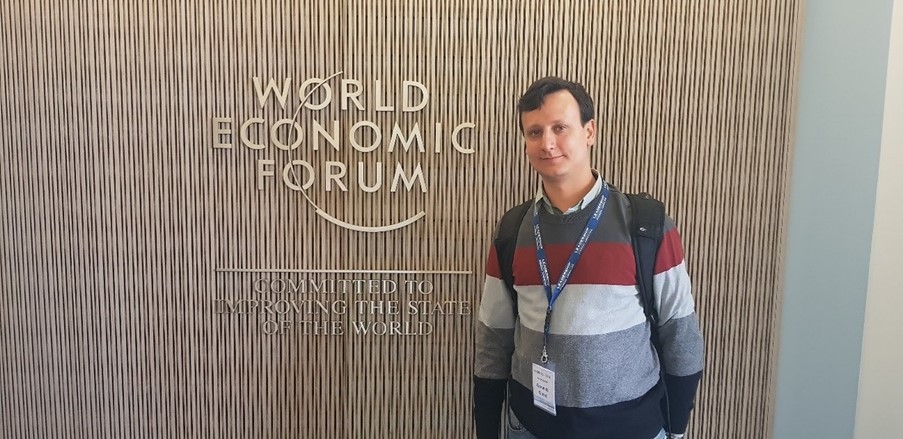
The last day of visits started at a refurbished military facility called Presidio near to the famous Golden Bridge. We headed to the World economic forum center for the 4th industrial Revolution to have a session about this recently created center and to talk about one specific emergent technology, Blockchain.
The World Economic Forum is the international organization for public-private cooperation and aims to engage the foremost political, business and other leaders of society to shape global, region and industry agendas.
According to the WEF: “The fourth industrial revolution – the current period of rapid, simultaneous and systematic transformations driven by advances in science and technology – is reshaping industries, blurring geographical boundaries, challenging existing business, and even redefining what it means to be human.”
The Forum´s Center for the Fourth Industrial Revolution is a newly established focal point within the international community for multistakeholder dialogue and concrete cooperation on governance challenges and opportunities presented by advanced technologies. It serves as a public-private platform for the collaborative development and refinement of frameworks and protocols that more fully anticipate risks and accelerate social benefits of technology.
In practice, the center brings together governments, business organizations, dynamic start-ups, civil society, academia, and international organizations to identify and prioritize game-changing impacts of emerging technologies, co-design innovative governance protocols and policy frameworks, and pilot and scale them with partners around the world.
They are focusing on 7 pillars:
AI and Machine Learning -> Project areas: decision-making tools for corporate boards, protocols for government use of AI, and standards for AI targeted at children;
IoT and connected devices -> Project areas: prioritizing security during IoT design process, bolstering public privacy protection, advancing transparency and openness, and mobilizing market forces for equality;
Blockchain and distributed ledger technology -> Project areas: digital identity and certification, supply chain integration, smart contracts, and currency and monetary systems;
Autonomous and urban mobility -> Project areas: scaling insights from the City of Boston pilot project, developing city-wide mobility and data management platforms, launching the New Mobility Coalition and building CityWeb knowledge platform for city transportation officials and leading executives;
Drones and tomorrow´s airspace -> Project areas: New paradigms for drone regulation, drone delivery for remote populations, policies for drone-delivered data, reimagining aircraft certification and protocols for medical delivery.
Precision medicine -> Project areas: generating evidence of precision medicine´s effectiveness, data-sharing, and related infrastructure, integrating a precision medicine approaches to regulation, pricing and reimbursement for diagnostics and treatment, and patient and public engagement;
Digital trade and cross-border data flow -> Project areas: developing a regulatory toolkit for e-payments, new policies for enabling e-commerce, a risk-based approach to data policies and accelerating innovation in trade economy.
Heading to the Hyatt Regency San Francisco Hotel, we met Jonathan Littman and his wife. He gave us a lecture about innovation and design thinking and shared with us his experience after more than 30 years of professional experience. We put in practice his methodology to create a new product or service for people in San Francisco. Guess which group won the competition ?.
During the session, Jonathan shared with us a summary of his book, The Ten Faces of Innovation. If you haven´t read, please buy one copy for you today.
The last session of the day was at Wework, another famous co-work places around the bay area. We visited the facilities and had a session about AICEP Portugal Global, an independent public entity of the Government of Portugal, with the goal of attracting foreign investment to Portugal and supporting the internationalization of Portuguese companies into the global economy.
But the most interesting part was the Pitch session, where we could put in practice what we´ve learned during the seminar and test our pitches. Each one of us delivered a pitch followed by group feedback. It was definitely a great learning experience.
That was it. Four days of visits and talks and the seminar was done!
On the fifth and last day, we had only a morning session to wrap up and discuss what we’ve learned during the week. We had also a speech on how to be an innovator leader and how to implement innovation in our companies. But this is a topic for another article.
This third article about my experience at Silicon Valley will talk about elevator pitch, Intel, Google, and Carbon 3D.
The third day started at the hotel meeting room with a presentation on how to deliver an elevator pitch. The process is simple but not easy as it demands a lot of training and rounds of practice and improvement.
Besides all those pomp and circumstances around start-ups´ pitches, everyone should dominate the art of selling effectively an idea or even themselves in a short period of time.
The framework presented is composed of 3 main steps: The catch, the core, and the closing.
The catch part is the most important one because if you are not able to connect and make people interested in listening to you, doesn´t matter what comes next. The first 30 seconds will drive the effectiveness of your pitch and must attract peoples´ attention with one single sentence.
The core must make clear the highlights of your value proposition always mentioning the needs of the market, your commitment to deliver, the benefits or values you bring to the table and how do you differentiate yourself from the competition.
Lastly but not the least, comes the closing. The golden rule here is to test the audience´s interesting and not be afraid to ask what you want (money, follow-up meeting, make a job offer, ask for a job, etc.). Keep eye contact, do not lower your voice and show enthusiasm.
A great example can be seen in this video of a young guy who won an elevator pitch competition.
Pitch session done. Now, jump on the bus to face another 2 hours traffic to reach Mountain View.
The first agenda of the day was a visit to the Intel museum on the ground floor of Intel´s office. Nothing very clever to share here but was great to remember the history of a great company that has disrupted the computer science world. We also learned how Intel´s chips are made from Silicon.
Actually, there is an interesting though that worth sharing, which is one of the most famous phrases by Robert Noyce, one of Intel´s founder. These words could not be more suitable for the Silicon Valley ecosystem!
Moving forward to Googleplex, we were hosted by Jason Amarante one of Google´s Program Managers. He is working on google voice product that is the competitor of Amazon Echo. For him, Google’s competitive advantage in this market is the amount of data that Google “control”.
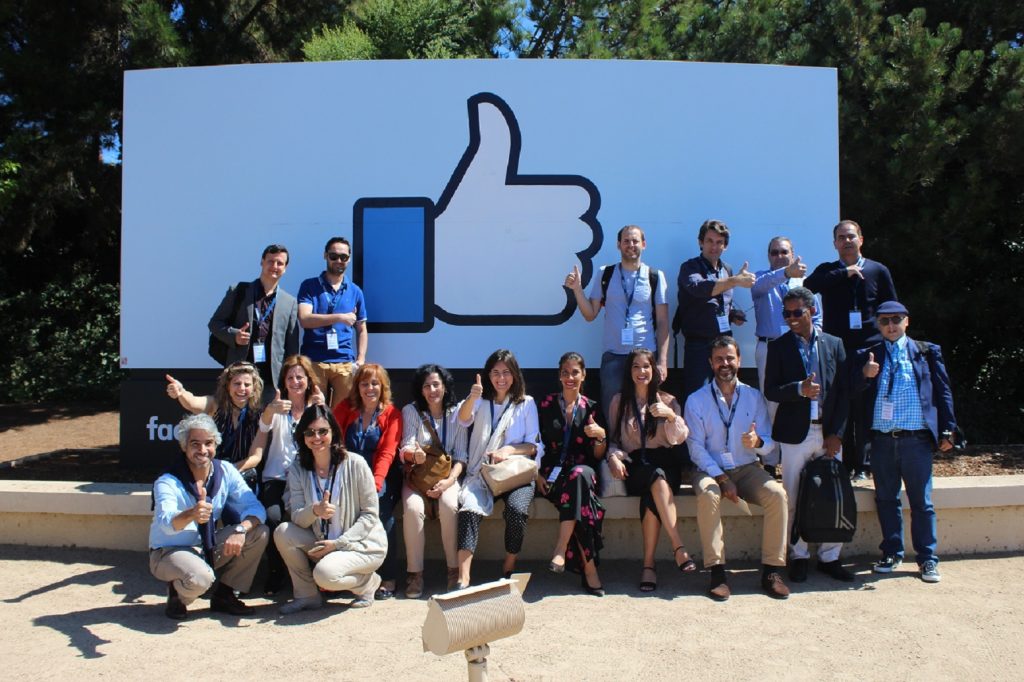
We visited only the outside part of the complex as we were not allowed to go inside of any building. By the way, to enter Facebook´s village you need to be an employee or be with one as a host. At Google, anyone can walk around and visit the outside facilities.
Not surprisingly, Google has very similar amenities at its employees’ disposal as Facebook. But in this case, was kind of weird to see 4 employees playing beach volleyball in the middle of the day and during working hours.
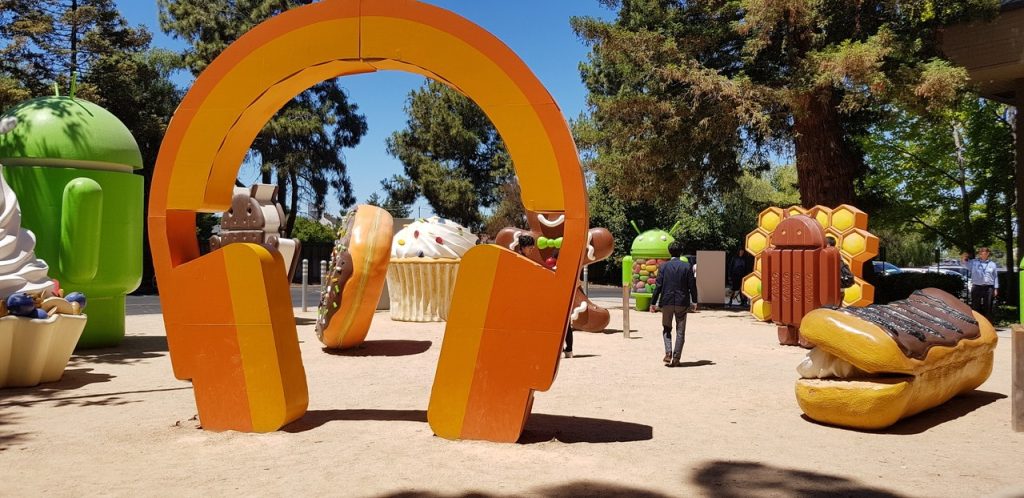
We also visited the place where Google keeps all Android versions´ symbol. For each version, there is a different symbol, they are all related to candy and follow the alphabet order.
Cupcake, Donut, Eclair, Froyo, Gingerbread, Honeycomb, Ice Cream Sandwich, Jelly Bean, KitKat, Lollipop, Marshmallow, and the last one Oreo.
As an ex-project manager, I was also curious about which software they use to control projects and report status. Jason said that they use everything from Google, meaning everything on google drive, no Microsoft Office at their desktops and Hangout instead of WhatsApp for internal communication.
Next stop: Fintech world. We arrived at Credit Sesame, one of the most successful fintech startups in the US, and were received by the company´s CIO, Pejman Makhfi. Pejman explained to us the company´s business model and how they were able to raise US$ 77 million from 5 rounds of fundraising. You can search more about the company here.
However, what stroke me most was the fact that the PowerPoint presentation used, the same used to present the company to VCs, were impressively simple! Seriously, imagine a blank slide (zero background), with I title without any different format than bold and a diagram with simple arrows connecting databases and other figures. All slides were like that!
So, if you think you need design and some beautiful slides to sell your idea or project, you might be wrong. I´m from a theory that the level of beautifulness in a presentation is the opposite of the level of content. But I´m not saying that good slides that make some explanation easily are not important.
The next stop was the 3D print company called Carbon. I thought that I was going to visit a company that prints stuff using 3D technology. However, during the tour, I realized that their business is actually manufacturing 3D printers and produce specific resins to use as supply. It was like visiting Xerox when they started to produce copy machines and sell tonners as supply.
I strongly advise you to watch the TED talk delivered by the company´s founder in which Joseph DeSimone explains their cutting-edge 3D print technology. They have more than 100 patents on this technology and a partnership with Adidas to print midsoles for its Futurecraft 4D sneakers (see picture). They will produce 500 thousand this year and are expecting to print 5 million per year by 2020.
The day ended in an amazing event hosted by Reed Smith, one of the biggest law firms in the world. Good food, good drinks, and amazing people to connect with.
In July I had the opportunity to participate in a one-week journey of leadership, innovation, and network in San Francisco and Silicon Valley, the GSI (Global Strategic Innovation Executive Program). On this second article, I´ll share my experience about the second day when we visited Facebook, Stanford University and Plug & Play.ond day started very early as we needed to commute from San Francisco to Mountain View and Palo Alto.
Allow me to take a break here and mention how bad is the traffic between San Francisco and Silicon Valley! Took us almost 2 hours to reach Facebook´s village.
Anyway, let’s get back on track…
We visited just one of many Facebook´s offices around there and was enough to confirm what is being said about the company. They definitely have created something different and nailed the “culture in practice” kind of strategy.
They have a huge fleet of busses all day long that brings and sends employees home even from places as far as 90Km away (with Wi-Fi, of course, so they can work on the way). I could just write one entire article to share what they provide as “benefits” for employees. All of it to try to motivate employees, foster innovation and, of course, hold employees for a longer period (on average, employees are staying at this kind of companies less than 3 years before moving out to another challenge). I already mentioned recruiting challenges at the bay area in the article about the first day, so companies are creating different strategies to hold the best guys.
If you send me a message, I can send you the video that I made inside the village.
With expectations already high, we reached the Stanford University to listen and have lunch with Professor Burton Lee, professor, and researcher on European Innovation & Entrepreneurship. The goal was to talk about the key features of Silicon Valley Trends and Global Tech as well as making some comparison to the European environment and culture.
Among a bunch of smart discussions, his four main topics were SCALE, SPEED, COMPETITON FOR TALENT, and CORPORATE CULTURE, ORGANIZATION, LEADERSHIP & STRATEGY and I´ll do my best to share the main thoughts on each topic.
Please bear in mind that these ideas have authoring rights by Prof. Burton Lee, so if you use them, please don’t forget to cite Prof. Burton Lee, as I have done here!
Scale
His point about scale is related to how emerging technologies such as big data, AI, blockchain, IoT are not only enabling new markets but also allowing companies to reach a scale speed that was not possible before! He also made a very interesting comparison between assets driven companies to tech-driven companies in terms of market valuation (which as we know is more about scalability than book value itself nowadays).
The graph is from 2015 and compares only US and Germany, but I believe is enough to prove his point. For instance, what is the main way for BMW to grow? Sell more cars. But to sell more cars they need to invest upfront and heavily in manufacturing facilities that worth billions. Now, what is the main way for Google to grow? Just hire more engineers! Of course, I´m simplifying the scenario to make my point, but you get it.
As we are mentioned cars and technology I´ll finish this topic with a strong prevision by Professor Burton Lee. He said that in the near future, software inside the cars will value more than the car itself! Do you agree?
Speed
Scalability leads naturally to speed! Or vice versa 😉
It took about 75 years for the telephone to connect 50 million people around the globe. Recently, a simple app like Angry Birds can reach that same milestone in a matter of days! In the past 10 years, the rate of adoption of new technologies has accelerated at a dizzying speed. Can we keep up with it all?
Competition for Talent
It´s the third time that this topic pops up during the seminar. And it is not a coincidence at all as numbers such those on the graph speaks for itself.
According to business inside“Oracle offered at least one candidate a $6 million package made up of salary and equity incentives to convince them to join the company, a source told Business Insider.”
From the same Business Inside article: “In October, the New York Times reported that the typical salary for PhD-trained AI talent is around $300,000 to $500,000 in salary and equity, but that some well-known people in the field make double-digit millions”
Are you as CEO, founder or even director willing to write a higher check for someone below you at the organizational structure? If not, I´m sorry. You definitely need to change your mind.
This topic is a Ph.D. thesis itself. Dr. Burton Lee spent some time here comparing different types of organizational structure and how it can influence a company´s culture. We discussed, for instance how Microsoft was able to change from a cross-department competitive culture to a more collaborative one.
He also showed us a study from Google after years studying effective Google´s teams. They came up with 5 traits that the most successful ones shared.
1. Psychological safety: Team members feel safe to take risks and be vulnerable in front of each other;
2. Dependability: Team members get things done on time and meet Google´s high bar for excellence;
3. Structure and Clarity: Team members have clear roles, plans, and goals;
4. Meaning: Work is personally important to team members;
5. Impact: Team members think their work matters and create changes.
Another conclusion in this kind of study from Google was some key qualities of team members identified.
“What matters isn’t so much who’s on your team, but rather how the team works together”
What mattered most: Trust / Listen first / Show empathy / Be authentic / Set the example / Be helpful / Disagree and commit / Be humble / Be transparent / Commend sincerely and specifically
Regarding this topic, Burton Lee recommends to us a book called “Team of Teams”, by Chris Fussell, David Silverman, Stanley A. McChrystal, and Tantum Collins.
In the end, after almost 2 hours of very interesting discussions, he stated as a conclusion that “Speed of innovation & Decision Making + Competition for talents and markets shape Corporate Culture and Structure.”
This whole session just reinforced what Peter Drucker said: “CULTURE EATS STRATEGY FOR BREAKFAST”! This is a personal battle that I had to fight over my 10 years of professional experience. Most of the time what we see is Top Executives just trying to impose what they think is the best strategy or culture for the company with beautiful slides and marketing initiatives after spending millions of dollars with a big four consulting firm. Same works for the culture of innovation. Almost every company wants to have innovation on its DNA, but most of them are doing wrongly stating with the solutions in mind (ex: implement an app, use IoT, etc.) rather than focusing on creating an enabling culture to foster innovation. But this is a discussion for another article.
As Burton Lee also stated: “Company Culture is the core of Innovation Platform”.
To complete this already amazing day, we went to visit Plug and Play. Our host was Jackie Hernandez, the SVP of Operations & Customer Engagement. Apart from being a very charismatic person, she works for the group for 12 years and saw all the road being built by the company´s founder and CEO, Saeed Amidi.
Plug and Play was the crib of some famous unicorns such as Google and PayPal.
They are an innovation platform that brings together the startups and the world’s largest corporations. If you are from an early stage startup, you should definitely subscribe to be part of their (disclaimer, they do not require equity as investors!) They invest in over 250 startups a year and have connections to 300 of the world’s best VCs.
During the visit, we had also the chance to interact with Gideon Marks, a very experienced startup mentor at Plug & Play. He shared with us his thought and lessons learned about startup funding. An interesting one that I took for me was his advice to never report efforts, but always report PROGRESS! Doesn´t matter how hard you worked or what sacrifices you made, the results and progress will separate success from failure and amateurs from professionals.
“You gain knowledge by listening, so develop big ears like an elephant. But stay away from talkers, with a big mouth like a hippopotamus”
My conclusion here is based on numbers. Plug & Play, for instance, evaluate over 10.000 startups every single year, they select then 250 to invest or accelerate and only 1 is expected to become a unicorn! You do not need to be a unicorn to be successful in the startup environment, but you have this goal, keep this numbers in mind, but never drive your decisions or give up because of these odds. Not everyone will, but anyone can succeed!
That´s it for the 2nd day. But before reaching the hotel in San Francisco we had to face the terrible 2 hours traffic again!